Why your mini split blows cold air in Utah

Describe what your mini split is doing once, in one form.

Start one form

A mini split that blows cold air when you've got it set to heat usually means the system is stuck in defrost, or the reversing valve that switches it between heating and cooling isn't moving all the way. In Utah, cold snaps make defrost cycles more frequent, and during defrost the outdoor unit clears frost off its coil while the indoor head can blow cool or room-temperature air for a few minutes. That's normal if it's brief. If it runs cold for longer than that, or never switches back to warm, the reversing valve is likely stuck, or the unit is low on refrigerant. A dirty air filter or blocked outdoor coil can also keep the system from pulling enough heat to feel warm at the vent. Either way, it's not something that clears up by waiting it out, and running it stuck mid-cycle wastes power without heating the room.

A smiling woman with dark shoulder-length hair in a cream V-neck sweater sits at a marble counter with a glass of red wine, with a kitchen and softly lit living room behind her.
A woman in a dark green sweater laughs while seated at a marble kitchen island with a glass of red wine, with open shelving, cabinets and a living room visible behind her.
A woman with long dark hair in a cream knit sweater laughs while looking off to the side, seated at a counter with a glass of red wine, in a dimly lit living room with a sofa, lamp, framed pictures and houseplant behind her.
A smiling woman with long dark hair in a beige sweater sits at a marble kitchen counter with a glass of red wine, with a dimly lit living room behind her.
A white wall-mounted mini-split air conditioner unit installed high on a light gray interior wall below crown molding, with a bamboo-shaded window at the lower left.
A clean mini split still throwing heat on a cold night cycles into defrost now and then, and the air runs cool for a few minutes before it warms back up.
A wall-mounted mini-split air conditioner indoor unit with a dusty, discolored cover, installed near the ceiling on a plain light-colored wall.
A dusty, discolored unit that blows cold and stays cold points to a reversing valve stuck partway, not a short defrost cycle.
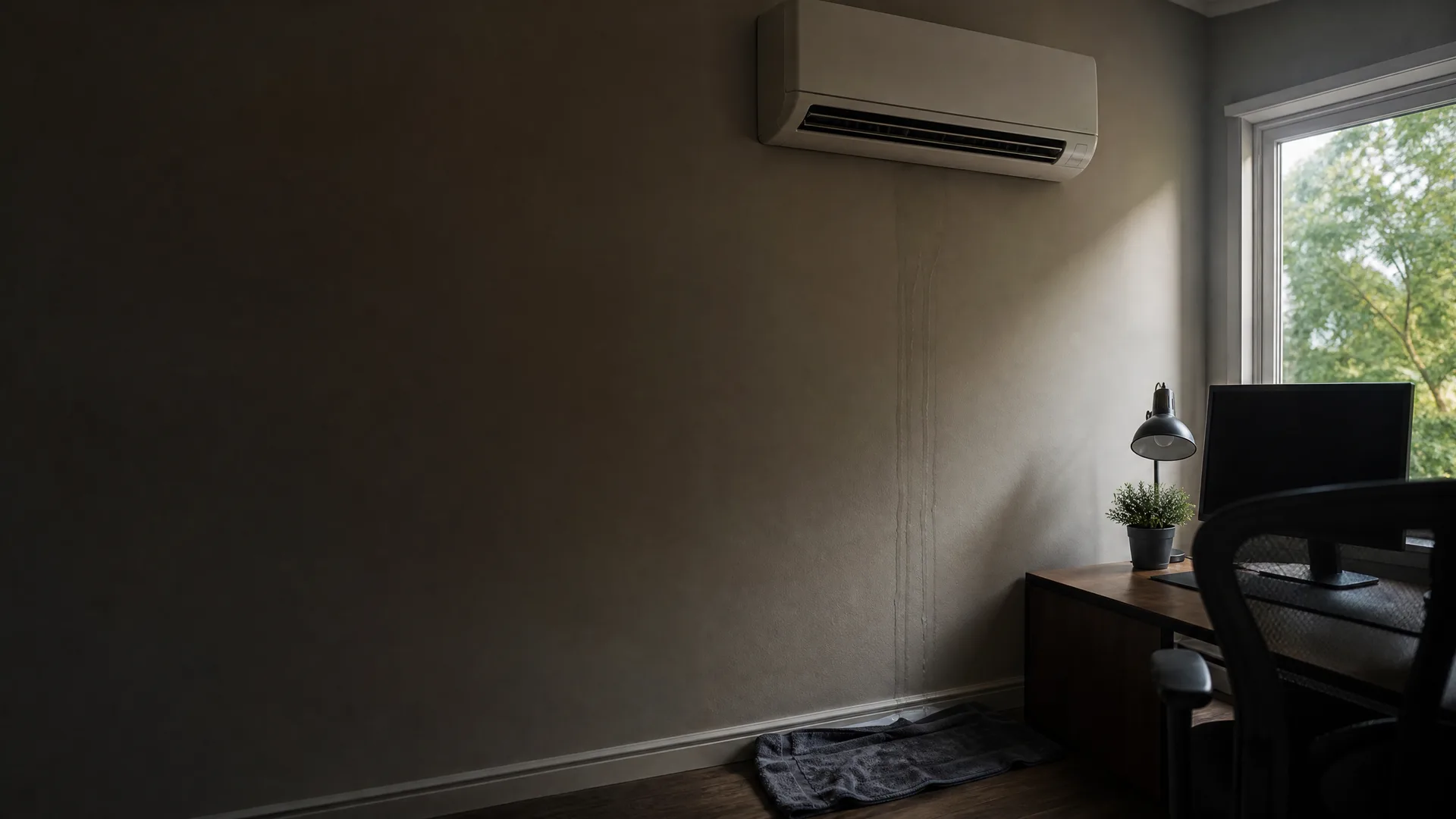
A dim room with a wall-mounted mini-split air conditioner above a faint vertical stain running down the wall, a folded grey towel on the wood floor at the baseboard, and a desk with monitor, lamp, small plant and office chair by a window.

You're at your desk on a July afternoon, the mini split above you set to cool against the dry Utah heat, when you notice the wall underneath looks wrong. A streak has worked its way down from the indoor unit, dark against the paint, and the air below it feels damp. You get up, put a hand under the unit, and find water dripping steady enough that you've already gone for a towel. The laptop goes to the other side of the desk. The towel soaks through faster than you expect. You stand there a minute watching the next drop form at the corner of the unit before it falls.


Defrost Cycle or Stuck Valve

Stuck in defrost

  • The outdoor unit ices up in cold weather, and the system reverses itself for a few minutes to melt it off, sending cool air inside while it works.
  • A contractor can often confirm this by watching the outdoor coil through a cycle or two, checking frost buildup against the defrost timer.
  • If the cycles are short and the air warms back up on its own, the reversing valve is doing its job, and the fix is usually smaller, a sensor or a control board.
  • This shows up more on nights that drop well below freezing, since the colder the coil gets, the more often it has to clear itself.

Reversing valve stuck

  • The valve that switches the refrigerant flow between heating and cooling gets stuck partway, so the indoor unit keeps blowing cold no matter what the thermostat says.
  • Unlike a defrost cycle, this doesn't correct itself. The air stays cold for as long as the system runs.
  • A failing valve often comes with a clicking or buzzing sound near the outdoor unit as it tries and fails to shift position.
  • This calls for a licensed contractor who works on mini splits regularly and can test the valve's coil and pressure readings directly rather than swap parts and guess.
  • Left alone, a stuck valve usually gets worse, and it can put added strain on the compressor.
A white wall-mounted mini-split air conditioner installed high on a beige interior wall below crown molding, with a window and light curtain on a black rod at right.

Running as it should

This is a mini split doing its job. Warm air moves out of the vent, the wall underneath stays dry, and any cool air you feel is just a short defrost cycle finishing up. No streaks, no dust built up on the casing, no cold air that lingers.

A wall-mounted mini-split air conditioner indoor unit with a dusty off-white casing and dark lower vent, installed high on a plain light-colored wall below a ceiling molding.

Stuck and cold

This one stays cold and doesn't recover. The casing has gone dusty and discolored, which means it's been overdue for a cleaning, and a reversing valve that can't fully switch will keep sending cool air no matter what the thermostat says. A contractor who works on these year-round can tell which one it is.

How does a mini split know when to go into defrost mode

You've seen the mini split switch to cool air for a few minutes mid-heat cycle and want to know what's actually triggering that, rather than just being told it's normal. With Utah's cold snaps bringing the outdoor unit near or below freezing, you're wondering what the system is measuring and what makes it decide the coil needs clearing.

It reads the outdoor coil temperature and run time, not the weather

A sensor clipped to the outdoor coil tracks its temperature as the unit runs. Once that coil sits cold enough for long enough, usually after a stretch of frost building up on it, the control board reverses the valve and runs in cooling mode just outside, which pushes hot gas through the outdoor coil to melt the ice off. That's the cold air you feel inside for a few minutes. On a clear, dry Utah night above freezing, the coil may never get cold enough to trigger it. On a damp, near-freezing night, frost builds faster and defrost kicks in more often.

  1. The outdoor coil picks up frost during a cold snap.

  2. A sensor reads the frost buildup and signals the control board.

  3. The reversing valve shifts and runs the system backward.

  4. Hot gas routes through the outdoor coil to melt the frost.

What are you noticing with your own mini split right now

You've got it set to heat, and every so often the air coming out turns cool instead of warm, sometimes for several minutes at a stretch. Maybe you've gone out and checked the outdoor unit and seen frost or ice built up on the coil. Maybe the room just doesn't hold its temperature the way it used to, and you've started reaching for a space heater to fill the gap. If you've noticed a streak on the wall under the indoor unit, or the air smells musty when it kicks on, that's worth attention too. Left alone through a Utah winter, a reversing valve that won't fully shift can mean longer stretches of cold air and a system working harder than it should on the nights you need heat most.

A smiling bearded man in a navy sweater sits at a candlelit dinner table with a glass of red wine, a bowl of salad, and plates of food in the foreground.
A woman with dark hair in a bun reclines on a sofa with her eyes closed, wrapped in a cream fleece blanket, a closed blue hardcover book resting in front of her, with a lit lamp and a vase of dried flowers in the background.

No phone calls to make

The pro who reaches out is licensed in Utah.

It costs nothing to send, and you don't have to hire anyone.

A single-story gray horizontal-siding house with multiple front-facing gables, white-trimmed windows, a dark front door, and a concrete walkway crossing a partly dry lawn under a clear blue sky.

Summer air here doesn't carry much moisture. The dew point averages 41°F across June, July and August, based on weather data for where Utah's homes sit, and that's dry enough that your mini split doesn't have to work hard pulling water out of the air to cool the room. Most of what it's doing is just moving heat. That matters when you're trying to figure out why the unit blows cold air at odd times. In dry heat like this, a short burst of cool air is rarely moisture in the system freezing something up. Look instead at the reversing valve or a defrost cycle kicking in when it shouldn't.

NASA POWER T2MDEW county cells weighted by homes

A dusty, stained wall-mounted mini-split air conditioner indoor unit near the ceiling on a plain beige wall, with visible lint buildup at its intake grille.
Before you get your mini split repair
A white wall-mounted mini-split air conditioner installed high on a beige interior wall near the ceiling, with a white-framed window at the left edge.
After you get your mini split repair

Inside the Reversing Valve

  • The reversing valve is a four-way valve that swaps which coil acts as the condenser and which acts as the evaporator.
  • A solenoid on top of the valve shifts a slide inside when it gets voltage, and that slide routes the refrigerant.
  • If the slide only moves partway, refrigerant leaks past it in both directions at once and the indoor coil never fully switches over.
  • A failing valve often makes a faint click when it tries to shift, even when the air coming out never changes.
  • Low refrigerant charge can keep the valve from shifting cleanly because there isn't enough pressure behind it to push the slide all the way.
  • A contractor can check valve position by feel, comparing the temperature of the pipes going in and out of it during a heat cycle.

The reversing valve is what lets one mini split heat and cool the same room, and it does that by changing which coil the refrigerant flows through first. When you set the system to heat, a solenoid on top of the valve gets voltage and pushes a slide inside from one end to the other. That slide decides whether the outdoor coil or the indoor coil acts as the condenser, the part that releases heat instead of absorbing it. When it works right, the switch happens in under a second and you never notice it.

Problems start when the slide doesn't make it all the way across. A valve can get voltage, start to move, and stop halfway, especially if something in the system is working against it. Low refrigerant charge is one cause, since the slide depends on pressure from both sides to push it into position, and without enough charge there isn't enough force behind it. A slide stuck in the middle lets refrigerant leak past in both directions at once, so neither coil fully commits to heating or cooling, and the indoor coil stays partly cold no matter what the thermostat says.

This kind of failure often has a sound to it. A valve that's struggling to shift tends to click faintly right at the moment it's supposed to switch, even on cycles where the air temperature never actually changes. A contractor checking this will usually feel the pipes entering and leaving the valve during a heat cycle, since the temperature difference tells them whether the slide actually moved or just tried to.

Power costs 13.02 cents per kilowatt-hour statewide

At 13.02 cents per kilowatt-hour, running a mini split stuck cycling into defrost costs you something every time it happens, but it's not what drives the bill up. A reversing valve that won't seat right makes the unit work through extra cycles trying to hold a temperature it can't reach, and that's where the cost shows up.

EIA-861 2025 statewide residential average

A white wall-mounted mini-split air conditioner indoor unit on a light gray wall above a white baseboard and wood-look floor.

The vent stays warm

This is what a mini split looks like when the reversing valve is seating the way it should. The vane opens, the air coming off it stays warm, and the casing underneath is clean because nothing's been leaking or running long enough to collect dust.

A white wall-mounted mini-split air conditioner indoor unit installed near a textured ceiling on a plain beige wall, with visible dust and discoloration on its casing and vent.

The dust tells you it's been running long

Grime like this builds up over seasons, not overnight. A unit working this hard, cycling into defrost more than it should and running longer to make up for it, pulls more air across that housing and leaves more behind on it.

A closed silver laptop and a ceramic mug of dark coffee sit on a wooden table in front of two chair backs, with a kitchen counter, tiled backsplash, wooden cutting boards, a vase of greenery and a potted plant by a window behind.

If your mini split is still blowing cold air when it should be heating, the cause comes down to the reversing valve

A short defrost cycle on a cold morning is normal. Cool air that doesn't come back around to warm, dust or a streak under the indoor unit, a valve that won't fully shift, that's the system telling you something is stuck. You know by now which one you're looking at.

Finding out who actually works on these units, and getting someone out to look at yours, is the part that takes the evening. You'd be calling around, describing the same thing to each one, then sitting with a stack of quotes trying to guess who's worth the call back. A licensed contractor near you who services mini splits all year, through the cold snaps that bring this on, already knows what a stuck valve looks like on a unit like yours. One contractor gets the details once, and you go from wondering what's wrong to having someone who can tell you.

Interior corner with a beige sofa holding a dark green and a light cushion and a textured throw, a potted small-leaved tree beside a white-framed window, and a dark shallow bowl on a wooden coffee table in the foreground.
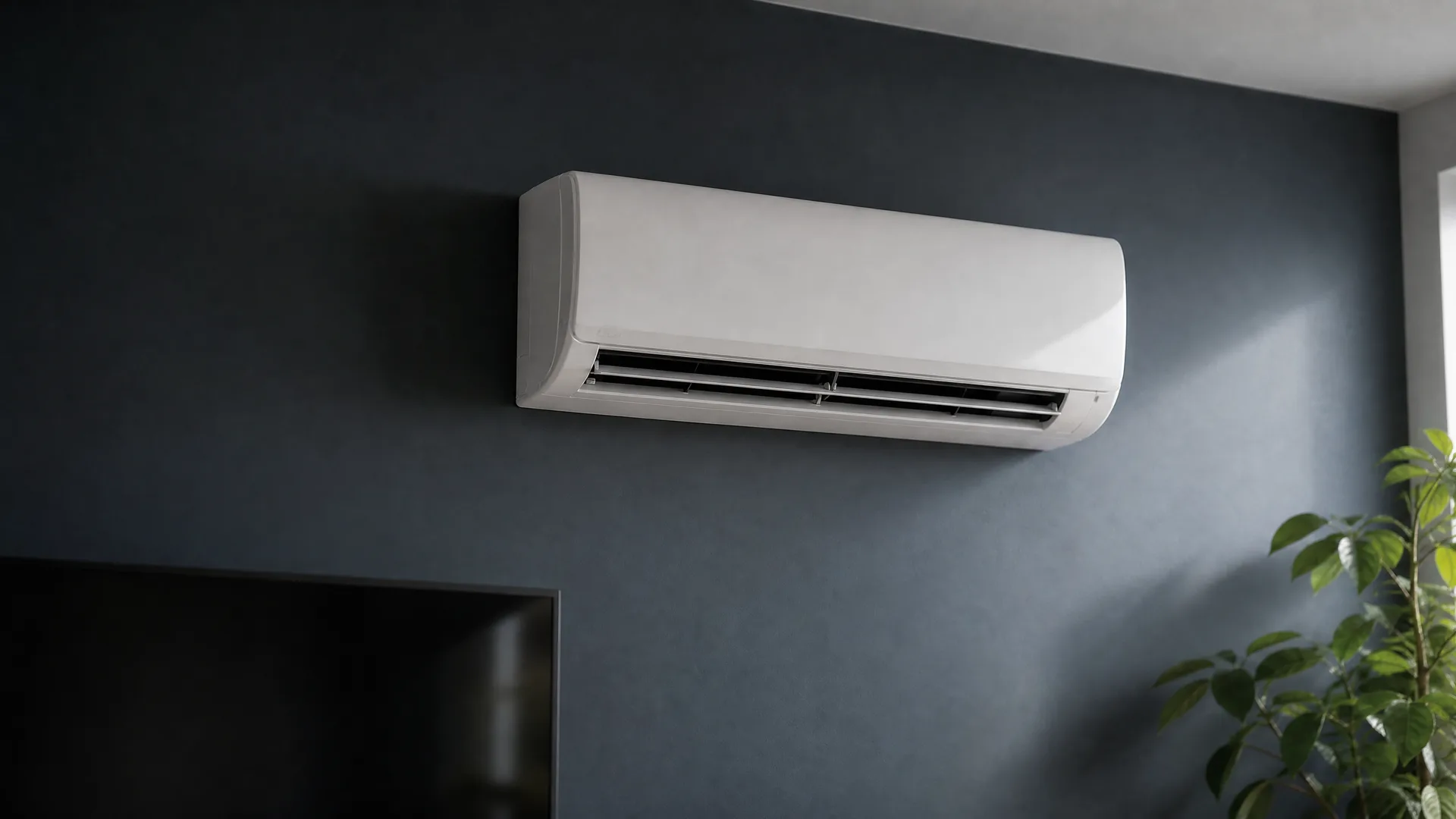
A white wall-mounted mini-split air conditioner on a dark gray interior wall, with a flat screen at lower left and a green leafy plant at lower right.

One form, no calling around

Step 1 of 3: Equipment