
A few minutes, a few times a day
That's roughly how long each defrost cycle runs. If frost keeps coming back heavier and faster than that, the coil or a sensor may not be working right.
That ice is frost pulling off the outdoor unit, and it's normal for a mini split working through a cold Utah night. The outdoor coil has to run colder than the air around it to pull in heat, and once that coil drops below freezing, the moisture in the air turns straight to frost on it. Your unit knows this happens. It runs a defrost cycle every so often, reversing itself for a few minutes to melt that frost off, and you'll sometimes see steam or hear the fan stop during it. That's the system working, not failing. The problem starts when the ice doesn't clear between cycles, builds up thick, cakes over the fan, or stays long after the outdoor temperature climbs back above freezing. That points to something keeping the unit from defrosting the way it should, and it's worth having someone look at before a cold snap leaves you without heat.
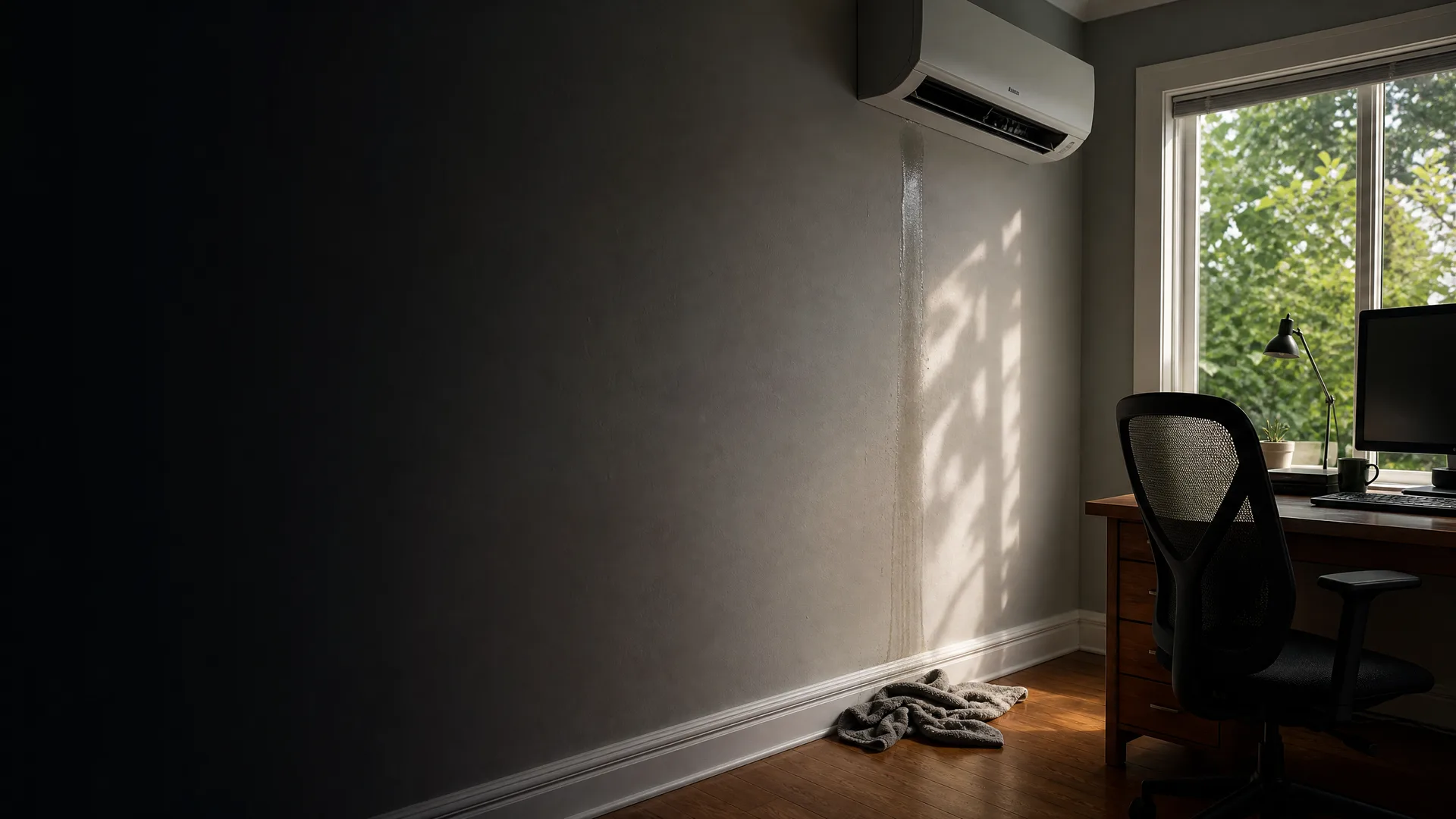
The image is wrong for this section. Frost on an outdoor unit in winter is one thing; a wet streak under an indoor unit in summer is another. But working only from what's described: it's a summer afternoon, and you're in the home office trying to get through a call when you notice the wall under the mini split has gone dark. Water is tracking down toward the baseboard. You grab a towel and press it against the wall, then look up at the unit, not sure if it's the drain line or the coil or something worse. The air coming off it still feels cool. You just don't know yet what's making it leak.


Your mini split pulls heat out of the outside air even when that air is cold, and doing that drops the outdoor coil below freezing. Frost builds on the coil the same way it builds on a glass of ice water. A control board on the outdoor unit watches coil temperature and runtime, and when it decides frost has built up enough, it reverses the system for a few minutes to melt it off. The outdoor fan shuts off during this, and you may see what looks like steam coming off the unit. That's just the frost melting and turning to vapor. Inside, the head you're sitting near keeps running the whole time, so you won't feel the switch happen. On a clear, cold night here in Utah, the coil can frost up faster than you'd expect, because even dry winter air carries enough moisture to ice up a surface that cold. None of this is the system struggling. It's the system doing the job it's built to do.




That's roughly how long each defrost cycle runs. If frost keeps coming back heavier and faster than that, the coil or a sensor may not be working right.
Ice that spreads past the coil, grows a shell of clear ice instead of white frost, or shows up indoors points to a problem a contractor needs to find.
You can see there's a pattern to the frost, it builds up over a few hours and then it's gone, but you've never actually watched it disappear. You want to know what the unit is doing on its own outside, in the cold, without you touching the thermostat or the remote.
The outdoor unit has a reversing valve, the same part that lets a mini split heat and cool. When the control senses enough frost on the coil, it flips that valve and briefly runs the system like an air conditioner, pushing warm refrigerant out to the coil instead of pulling heat in. That warmth melts the frost off. The outdoor fan shuts off during this so it doesn't blow cold air through a wet coil, and you may see steam or water coming off the unit. Once the coil is clear, the valve flips back and the unit goes back to heating your home. Indoors, the head either keeps running on residual heat or pauses for those few minutes, depending on the system.

The unit kicks off defrost on its own, melts the frost in a few minutes, and goes right back to heating. You might not even notice it happened except for a little steam coming off the outdoor coil. No ice lingers, nothing drips where it shouldn't, and the room still holds its temperature.

Dust caked on the casing and a filter packed with grime make the coil work harder than it should, and frost starts building faster than defrost can clear it. Left alone, ice spreads across the coil and the unit loses its ability to heat the room. That's when it needs a tech to look at it.


A mini split that won't shake the ice off, or grows it back within the hour, usually has a defrost sensor that's stopped reading right, a reversing valve that's stuck, or a refrigerant charge that's run low. None of those clear up on their own, and running the unit through more Utah nights in that state just adds strain to the compressor. You don't need to figure out which one it is. Someone local who works on these systems through the winter has likely already seen this exact pattern this season, on this same kind of unit, and knows where to look first. Send the request and a licensed contractor near you picks it up, the only one working your case, so you're not sorting through calls from five companies while your outdoor unit sits there icing over. That part stops being yours to manage. You just need the ice looked at before it's your heat that goes next.

That ice you're seeing outdoors has nothing to do with how humid Utah gets. Summers here run dry, averaging a dew point of 41°F at the homes around the state, per NOAA, which is why the air rarely feels heavy even on a hot afternoon. Frost on the coil is a winter problem, made by whatever moisture is in the cold night air, not by anything left over from summer. So if your mini split is icing up now, look at what's happening outside tonight, not at how the house felt in July. The two seasons put a very different load on the same unit.
NASA POWER T2MDEW county cells weighted by homes

This is what a mini split looks like when it's keeping up. Air moves out of the vents, the room holds its temperature, and the cabinet stays clean along the grille. Nothing about it needs your attention.

Dust and grime packed into the vents and the lower intake grille choke off airflow over the indoor coil. A coil that can't move enough air runs colder than it should, and that's part of what lets frost take hold and stay instead of clearing on its own.


At 13.02 cents a kilowatt-hour, running the defrost cycle on a mini split costs little, since it only kicks on for a few minutes at a time. A unit stuck defrosting for hours, or running nonstop to fight ice that won't clear, is a different story on your bill.
EIA-861 2025 statewide residential average
Frost on the outdoor coil on a cold night is the unit doing its job. It melts that off a few times a day through defrost and goes back to heating your home, and you were never meant to notice. Ice that stays, thickens, or turns up on the indoor unit is a different situation, and it traces back to one of three things: a defrost sensor that's stopped reading the coil right, a reversing valve stuck mid-cycle, or a refrigerant charge that's run low. None of those three fix themselves. Letting the system keep running while one of them persists just means the compressor works harder than it should, night after night.
Finding out which one you have takes someone who's looked at it before. A contractor who services mini splits through Utah winters has seen all three, and usually has a sense of which one is behind a given pattern of ice before they even open the unit up. That's the kind of read you want on your equipment, not a guess.
When you send a request through this page, it goes to one contractor, licensed and local to Utah, not a list of companies calling you back at once. You get one call, from one person who knows this equipment and this climate, and from there the ice stops being your problem to solve.





Your request goes to one pro, not a list of companies.
You're not committing to anything by asking.