
Why your mini split won't turn on in a Utah winter

Step 1 of 3: Equipment

Why won't my mini split turn on when it's cold outside?

Cold mornings in Utah can drop well below freezing, and when the mini split won't power on at all, it's easy to assume something has failed outright. Most homes here heat with gas, so the mini split may only be asked to cover one room or the shoulder months, which makes it worse when it goes dark right when you need it. You just want to know if this is normal or if something needs fixing.

Most likely a safety control is holding the unit off in the cold, not a breakdown

A mini split that won't power on when it's cold is usually protecting itself, not broken. Many units have a low ambient control that keeps the outdoor unit from starting below a certain temperature, since running the compressor on a frozen coil can damage it. On a hard freeze night in Utah, that control can keep the system from turning on at all until it warms up some. If yours never comes back once temperatures climb, or it won't start even on a mild afternoon, that points to something else, like a frozen coil that hasn't cleared, a tripped breaker, or a failed component inside the outdoor unit that needs a contractor to look at.

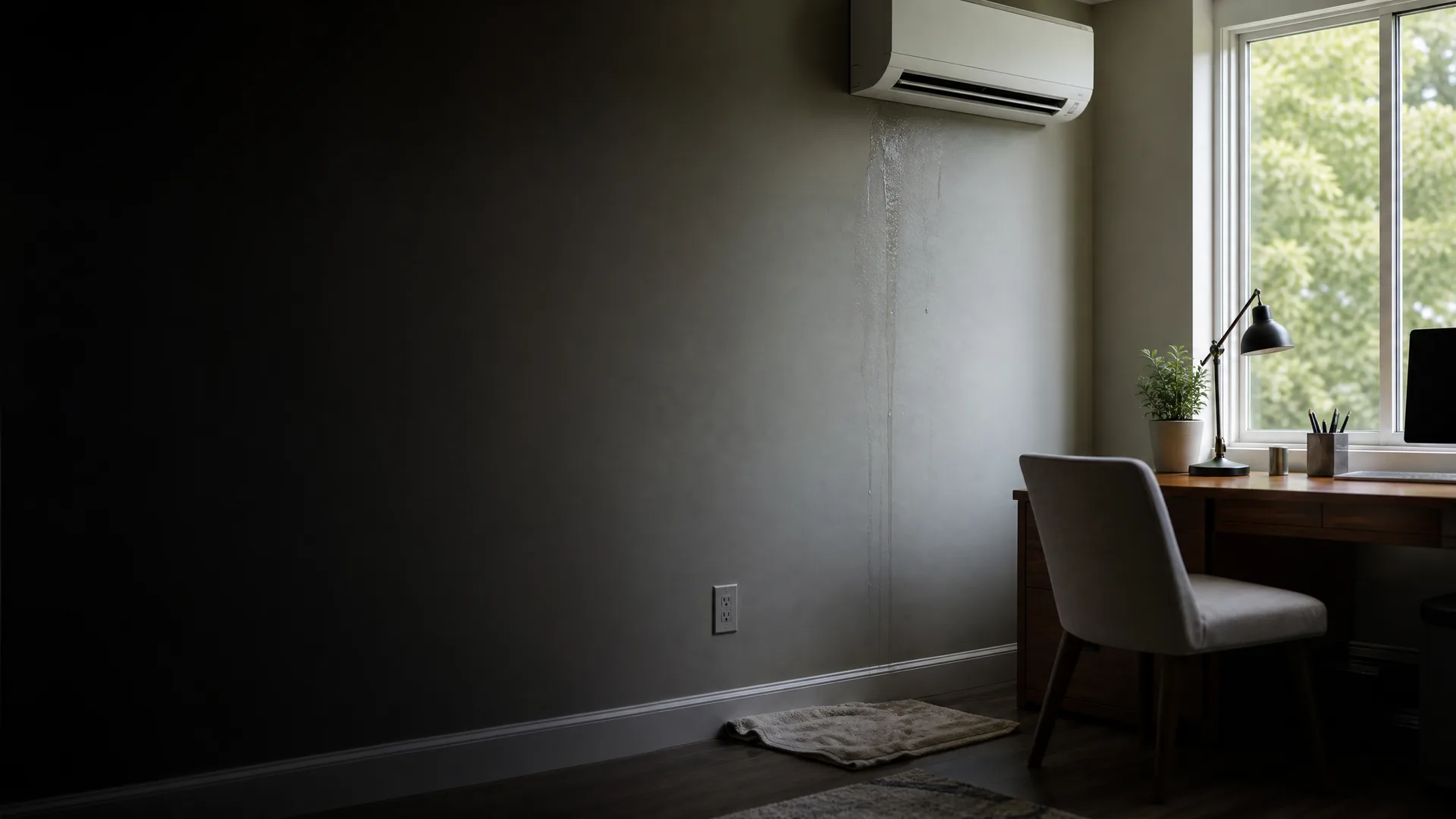
A dim room with a wall-mounted mini-split air conditioner above a vertical water stain running down the wall to a towel on the floor, with a desk, chair, lamp and potted plant beside a window.

You're at your desk on a July afternoon, the office window bright with sun, when you notice the carpet is damp under your feet. You look up and see a wet streak running down the wall below the indoor unit, pooling on the sill before it drips. You grab a towel and press it against the base of the unit, but water keeps finding its way out from behind the casing. The unit still blows cold air. It just won't stop leaking. You check the line outside, half expecting to see water running from it, but nothing's there. Whatever's wrong, it isn't where you can reach it.

Power costs 13.02 cents per kilowatt-hour statewide

At 13.02 cents per kilowatt-hour, running a mini split here costs less than it does in most states. That's part of why a dead unit on a cold morning is worth fixing rather than living with. With gas heat as backup and power this cheap, a working mini split is cheap comfort for the rest of the house.

EIA-861 2025 statewide residential average

The unit just won't start

Nothing happens when you hit the button. No fan noise, no light on the indoor unit, no hum from the outdoor unit. This usually points to power getting cut somewhere between the breaker and the unit itself, a tripped breaker, a blown fuse in the disconnect box outside, or a bad connection at the unit. Cold doesn't cause this on its own. Something has to interrupt the circuit first. A contractor who works on these year-round can trace the power path and find exactly where it stops, instead of you guessing at which part is at fault.


It starts but won't heat

The indoor unit turns on, you hear it running, but no warm air comes out, or the outdoor unit won't kick on with it. This is a different problem than a dead unit. It usually means the outdoor unit is struggling in the cold, often from ice buildup on the coil that blocks it from pulling heat out of the outside air. Some systems handle this with a defrost cycle, and when that cycle isn't working right, the whole system stalls. A local contractor who knows how these units behave in Utah winters can tell quickly whether it's ice, a sensor, or something else.

A woman with long light-brown hair in a gray knit sweater sits in a living room looking off to the side, with a sectional sofa, houseplant, lamp, wooden table and large windows behind her.
A woman in a chunky gray turtleneck sweater sits indoors looking off to the side, with a blurred dining table, chairs, pendant lamp and window behind her.
A woman in a cream knit sweater with her hair in a bun stands near a window, looking off to the side, with a gray sofa, houseplant and open kitchen with pendant lights blurred behind her.
A woman with long brown hair in a cream knit sweater stands near a window, looking to the side, with a white sofa, shelving, and a hallway visible behind her.

Finding a pro stops being your job

A mini split that won't start on a cold morning isn't something to leave alone and hope it corrects itself. Utah winters push units into their defrost cycle more often, and that's exactly when a weak contactor or a frozen outdoor coil finally gives out. Waiting a few days to see if it comes back usually just means the same cold morning again, except colder. Someone who services these units all winter in this area has already seen whatever yours is doing, probably more than once this season. That's different from calling around and hoping whoever picks up knows mini splits as well as they know furnaces, which is what most of Utah runs on. One local contractor gets your request, not a handful of them competing for the callback, so you're not stuck fielding calls from companies you haven't vetted while your living room sits cold. You've already looked at the breaker and the thermostat. The next step is getting someone out who works on this equipment for a living.

Where This Leaves You

  • A mini split that won't power on at all usually means something is cutting power before it reaches the unit, not a dead system.
  • Breakers, blown fuses and disconnect switches outside near the outdoor unit are the first places a contractor checks.
  • Utah's cold mornings push units into defrost more often, which is often when a weak contactor or frozen coil finally fails for good.
  • A unit that runs but won't heat points to the compressor or refrigerant charge rather than the power supply.
  • Gas heat covers the house while the mini split is down, but a frozen or dripping unit left alone can damage the wall and flooring underneath it.
  • The fix usually comes down to one failed part: a breaker, a contactor, a sensor, or a frozen coil that needs to thaw and get diagnosed.

A mini split that won't turn on in a Utah winter almost always comes down to something getting between it and power, or something it can't handle on its own anymore. The breaker, a fuse, a disconnect switch outside, a contactor worn out from running the defrost cycle over and over on cold mornings. Sometimes the problem is further along: the unit powers up but blows cold air, or ice builds up on the outdoor coil and never clears, and that points to the compressor or the refrigerant charge rather than anything electrical. Either way, it's one part that failed, not the whole system giving out. Gas heat keeps the house warm while this gets sorted, so there's no need to rush a fix out of fear of the cold. What shouldn't wait is a unit that's frozen over or dripping water near the wall, since that kind of damage doesn't stop on its own and gets worse the longer it sits. Figuring out which of these it is from the couch isn't really possible. A breaker that looks fine can still be the problem, and a coil that looks frozen solid might just need the right diagnosis once it thaws. What matters now is getting someone who works on these units through a Utah winter to look at it directly, trace the power, check the parts that usually give out first, and tell you straight what's actually wrong.

A woman and a child wrapped together in a knitted gray blanket on a couch, with the child's head resting on her shoulder and a lit table lamp and houseplant in the background.
A smiling older woman with gray hair in a cream knit sweater stands in a dimly lit kitchen beside a window showing snow outside, with a round loaf of bread on the counter in the foreground.

Let someone else find the pro

A mini split that won't start on a cold morning has a cause, and a local contractor who works on these units all winter has seen it before. Send the request and the search for the right person is off your plate. You'll get one licensed Utah contractor, not a string of calls to field, someone who knows what the defrost cycle does to a weak contactor or a frozen coil this time of year. With gas heat as backup, there's no rush born of panic, just getting it fixed right.

Let a pro reach out

Only one pro gets your request, so you hear from one company.

No fee to send it, and nothing to sign.



